


‹ BackNewsProject Hangang

Project Hangang

South Korea c
2026-10-04 03:58:46

South Korea’s Crypto Market by 2030: How Institutions May Approach Stablecoins, Payments and Tokenized Assets

South Korea’s crypto market is already large by trading volume, but tokenized real-world assets remain small relative to local exchange activity. The source article argues that the country is moving into a new phase in which institutional participation, regulatory design and payment infrastructure matter more than retail trading alone. It points to Bank of Korea data showing about KRW 640 billion in tokenized real-world assets, versus 11.13 million eligible trading accounts and average daily crypto trading volume of KRW 5.4 trillion in the second half of 2025. The report lays out a 2030 scenario built around three tracks: KRW stablecoins operating alongside existing payment rails, backend settlement software becoming more valuable than consumer-facing payment interfaces, and tokenized real-world assets shifting from simple issuance toward global distribution and post-issuance operations. It also reviews overseas developments, including U.S. and European regulatory moves, tokenization efforts by major financial institutions, and examples such as UBS, J.P. Morgan, Hamco, Bridge, M0, MetaMask and Rain. For Korean institutions, the article outlines two routes. One is a domestic strategy focused on private ledgers and preparation for the local tokenized securities regime. The other is an offshore strategy aimed at global distribution under structures the Financial Services Commission said may fall outside the Electronic Securities Act under specific conditions. The broader conclusion is that timing matters: firms that move while rules are still being shaped may be in a stronger position once the market structure is finalized.

20
South Korea’s Crypto Market by 2030: How Institutions May Approach Stablecoins, Payments and Tokenized Assets
Bank of Korea
2026-09-21 06:52:34

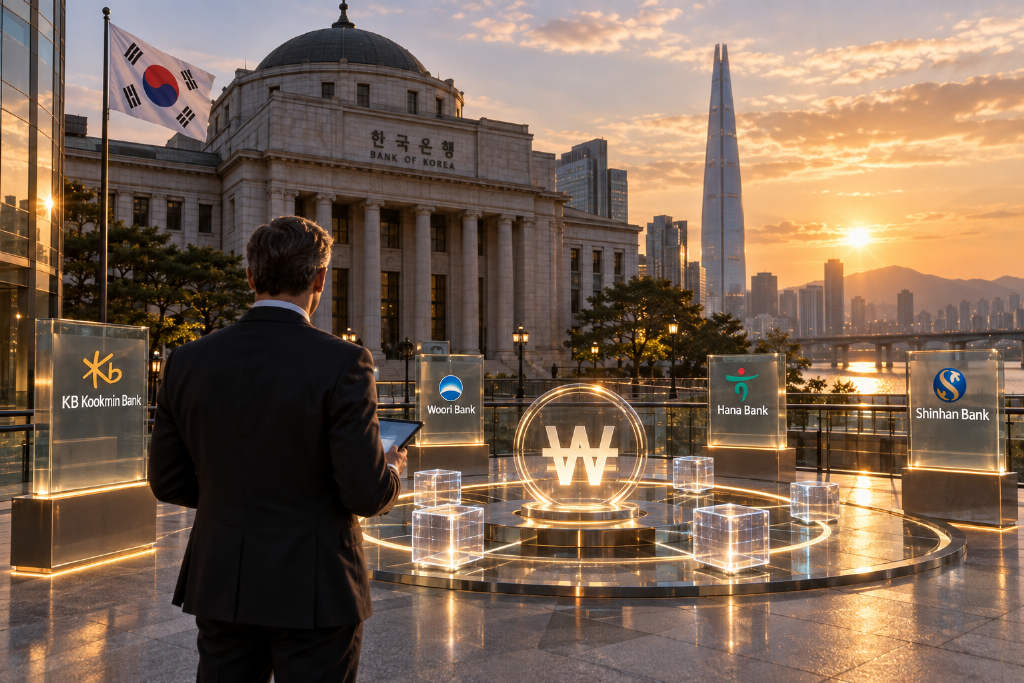
Bank of Korea begins pilot for 24-hour won settlement network

The Bank of Korea has launched its first pilot for a 24-hour won settlement network aimed at allowing foreign investors to settle won-denominated transactions outside normal banking hours in South Korea. On Monday, the central bank said its international remittance network had entered a test run with four local banks: KB Kookmin Bank, Woori Bank, Hana Bank, and Shinhan Bank. Full operations are expected to begin in January 2027, when participation will be expanded to other institutions and foreign banks. The network runs 24 hours a day on weekdays, excluding weekends and public holidays. Foreign investors can settle won transactions during business hours in their home countries through Registered Foreign Institution for Korean won business, or RFI-K, accounts, without opening accounts directly at South Korean financial institutions. The BOK said the network is expected to improve access to won settlement infrastructure for foreign investors and support the won’s international standing. The central bank also said it is involved in settlement infrastructure experiments tied to tokenization. It referenced Project Agorá, led by the Bank for International Settlements, which completed a real-value cross-border payment test in July using tokenized central bank reserves and commercial bank deposits, including the Korean won. Separately, the BOK is advancing Project Hangang, a blockchain-based pilot that uses wholesale central bank digital currency to settle tokenized commercial bank deposits.

320
Bank of Korea begins pilot for 24-hour won settlement network
LG CNS to Launch Stablecoin-Focused Blockchain Service in September
Bank of Korea to expand CBDC pilot in September with nine banks and deposit tokens for up to 500,000 users
South Korea launches deposit token payment infrastructure project for private-sector use
South Korea’s FSC approves Hangang CBDC phase 2, expanding to 9 banks and 500,000 accounts